How to Use ETC in Japan: A Complete Guide to Electronic Toll Collection
Driving in Japan is an absolute pleasure, characterized by immaculately maintained roads, polite drivers, and stunning scenery. However, because almost all expressways in the country are toll roads, the process of constantly stopping to pay fees can quickly become tedious and expensive. This is where the ETC (Electronic Toll Collection) system becomes an indispensable tool for any road trip. The ETC system allows vehicles to pass through highway toll gates automatically without stopping, wirelessly charging the toll fee to a registered card.
For international visitors renting a car, understanding how to obtain, install, and properly use an ETC card is arguably the most important administrative step of the entire journey. Navigating the toll plazas manually—fumbling for correct change or handing over credit cards to attendants while sitting in traffic—is stressful and time-consuming. This comprehensive guide will explain the immense benefits of using the ETC system, walk you through the exact process of passing through the automated gates safely, and clarify how to settle your final toll bill, ensuring your Japanese road trip remains as smooth and enjoyable as possible.
What is an ETC Card and Why Do You Need One?
Before you even start the engine of your rental car, you must understand what the ETC system is and why local Japanese drivers consider it an absolute necessity for highway driving.
The Basics of the Electronic Toll Collection System
The ETC system relies on two main components working together: an onboard device (the card reader) installed permanently in the vehicle, and a removable IC chip card (the ETC card itself) that is inserted into the reader. When a vehicle equipped with a valid ETC card drives through a designated ETC lane at a toll plaza, a wireless antenna communicates with the onboard device, registers the entry or exit point, and automatically calculates and records the toll fee. You simply drive through the gate, and the barrier lifts seamlessly.
Virtually all modern rental cars in Japan come pre-installed with the onboard ETC reader, usually tucked away inside the glove box, below the steering wheel, or integrated into the rearview mirror. However, the reader is completely useless without the actual ETC card. When the card is properly inserted, the device will usually emit a small beep and a green light will illuminate, often accompanied by a Japanese voice prompt confirming that the card has been authenticated. If the card is inserted upside down, or if you forget it altogether, the device will warn you with a red light and an error message. It is your responsibility to ensure the card remains securely in the slot for the entire duration of your time on the expressway. Taking the card out while driving can cause the exit gate to malfunction, leading to a highly stressful situation where you are stuck at the barrier holding up traffic.
Time and Money Saved by Using ETC
The most obvious benefit of using an ETC card is the sheer amount of time and hassle it saves. During peak travel seasons like Golden Week, Obon, or New Year’s, the manual toll lanes (marked in green for “General”) can back up significantly as drivers stop to pull tickets or process payments. With an ETC card, you bypass these queues entirely, gliding through the dedicated purple lanes.
However, the benefits extend far beyond just saving time; using an ETC card actually saves you a substantial amount of money. The Japanese highway authorities (NEXCO) heavily incentivize the use of the electronic system by offering significant toll discounts that are completely unavailable to drivers paying with cash. For instance, there is a “Late Night Discount” which reduces tolls by 30% if you are on the expressway between midnight and 4:00 AM. There is also a “Holiday Discount” which provides a 30% reduction on rural expressways during weekends and national holidays. These discounts are applied automatically when the system reads your ETC card. On a long road trip, such as driving from Tokyo to Kyoto, these automatic 30% reductions can easily save you thousands of yen. Therefore, securing an ETC card is not just a matter of convenience; it is a critical component of budgeting for a cost-effective Japanese vacation.
How to Get an ETC Card as a Tourist
While local residents apply for ETC cards through their domestic credit card companies, the process is completely different and much simpler for international tourists visiting Japan on a short-term basis.
Renting a Card Through Your Car Rental Agency
The single most effective and reliable way for a foreign visitor to obtain an ETC card is to rent one directly from the car rental agency at the same time they pick up their vehicle. Almost all major agencies, such as Toyota Rent a Car, Nippon Rent-A-Car, Times Car Rental, and Orix, offer ETC card rentals for a nominal flat fee, usually around 330 yen (about $2 to $3) for the entire duration of the rental period.
It is absolutely crucial that you explicitly request the ETC card when you make your initial car reservation online. During peak tourist seasons, rental offices can occasionally run out of the physical cards if they are not reserved in advance. When you arrive at the counter to collect your keys, the staff will hand you the ETC card and often demonstrate how to insert it into the onboard reader. You are taking full responsibility for the physical card, so do not lose it, as the replacement fees can be steep. Renting the card directly from the agency seamlessly connects your toll usage to your rental agreement. You do not need to link your own personal credit card to the ETC system; the rental company’s card covers the charges in real-time on the highway, and you simply deal with the agency later.
The Limitations of Buying Your Own ETC Card
Occasionally, tourists wonder if they can simply buy their own ETC card at a convenience store or electronics shop in Japan to use in their rental car. The short answer is no, this is practically impossible for a short-term visitor.
In Japan, ETC cards are strictly tied to domestic credit cards and bank accounts. To apply for a personal ETC card, you must be a resident of Japan, possess a valid Japanese address, and hold a credit card issued by a Japanese financial institution. The application process includes credit checks and takes several weeks to process before the physical card is mailed to the resident’s home. There are no “pre-paid” or “throwaway” ETC cards available for purchase over the counter. Therefore, relying on the rental agency’s service is truly the only viable option. If for some reason your rental agency cannot provide an ETC card, you must resign yourself to using the manual “General” toll lanes for the entirety of your trip, which means you must ensure you have plenty of Japanese Yen in cash (both bills and coins) readily available in your vehicle at all times, as not all rural toll booths accept international credit cards.
Step-by-Step Guide to Passing Through Toll Gates
Approaching a Japanese toll plaza can be intimidating the first time, but the process is highly standardized across the entire country. Knowing which lane to choose and how fast to drive is the key to a stress-free passage.
Approaching the Purple ETC Lanes Correctly
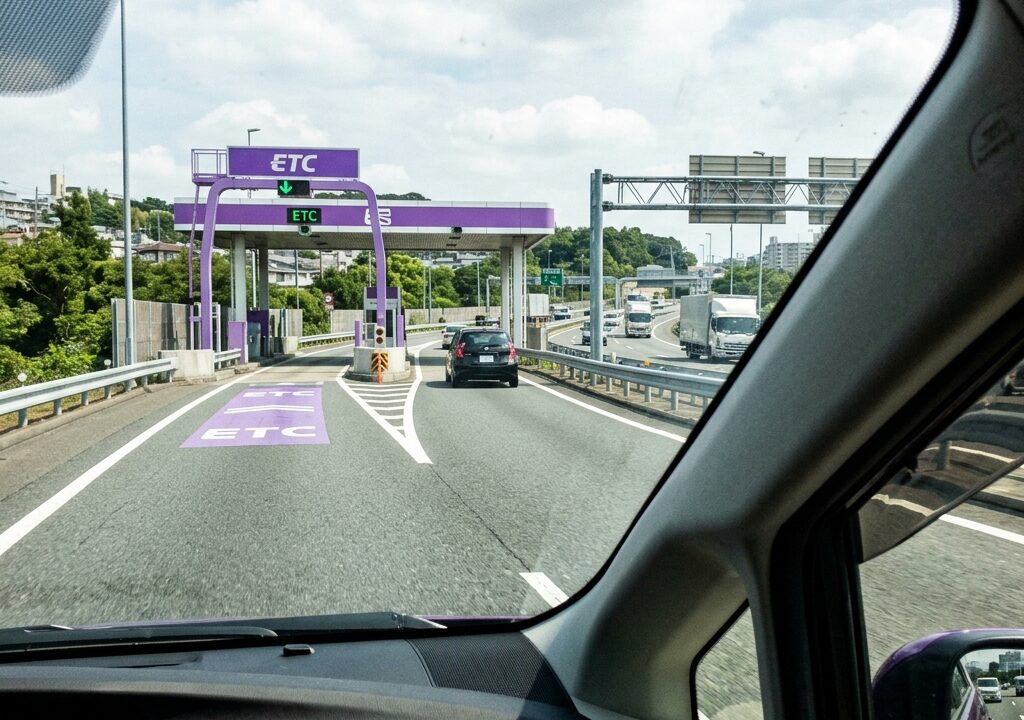
As you approach a toll plaza on the expressway, you will notice large overhead signs directing traffic into different lanes. The lanes are color-coded for clarity: purple lanes are dedicated exclusively for ETC users, while green lanes (marked “一般” or “General”) are for drivers paying with cash or pulling a paper ticket. Sometimes, you will see a lane marked with both purple and green; this is a mixed-use lane that accepts both ETC cards and cash payments, but it will be slower as the car in front of you might have to stop to pay.
- Identify the purple ETC lane well in advance and merge safely.
- Reduce your vehicle’s speed to exactly 20 km/h (about 12 mph) as you enter the lane structure.
- Maintain this slow speed; do not accelerate toward the barrier.
- The gate barrier will pop open just before your car reaches it, and a digital sign will display the toll amount. Proceed without stopping.
The 20 km/h speed limit is not merely a suggestion; it is a strict requirement for the system to function correctly and safely. The wireless communication between the overhead antenna and your car’s reader takes a fraction of a second. If you blast through the lane at 50 km/h, the sensor may not have enough time to authenticate the card, and the heavy physical barrier will not open, resulting in a dangerous collision. Furthermore, maintaining a slow speed ensures you have enough time to react if the car in front of you suddenly stops because their ETC card failed. Always keep a safe distance from the vehicle ahead while passing through the toll plaza.
What to Do if the Toll Gate Barrier Does Not Open
Despite the high reliability of the Japanese ETC system, errors can occasionally occur. The most common reasons a gate barrier fails to open are that the driver forgot to insert the ETC card, the card was inserted incorrectly (upside down or backwards), or the card is expired.
If you approach the purple ETC lane and the barrier remains down, your absolute first priority is safety: hit the brakes and come to a complete stop immediately. Do not attempt to smash through the barrier, and under no circumstances should you ever put your car in reverse and try to back out of the toll lane. Reversing on a highway toll plaza is incredibly dangerous and highly illegal. Once you are safely stopped in front of the barrier, turn on your hazard lights. Look for the intercom button located on the machine next to your window and press it to contact the toll booth staff. If you cannot reach the button, simply wait; the staff monitoring the cameras will notice the issue and an attendant will physically walk out to your car to assist you. You can explain the situation (or just hand them the ETC card if it failed to read), and they will process the entry or payment manually using a handheld terminal before opening the gate for you. Staying calm and waiting for staff assistance is the only correct procedure.
Understanding Smart ICs (Smart Interchanges)
As you explore more rural areas or look for specific attractions, you will likely encounter a special type of highway exit known as a “Smart IC.” These require a slightly different approach than the main toll plazas.
The Difference Between Regular Exits and Smart ICs
A Smart Interchange (Smart IC) is a specialized, compact, and fully automated toll gate designed exclusively for vehicles equipped with an ETC card. Unlike massive, multi-lane toll plazas that span the entire width of the highway, Smart ICs are often single-lane exits and entrances tucked directly into Service Areas (SA), Parking Areas (PA), or minor rural access roads.
The primary purpose of a Smart IC is to provide local residents and tourists with more convenient, direct access to specific towns, tourist spots, or commercial facilities without the massive infrastructure cost of building a full-scale interchange. For example, you might use a Smart IC located inside a Service Area to immediately access a famous hot spring or a shopping mall located just outside the highway fence. Because these gates are entirely unmanned, they rely completely on the ETC system. If you are driving a car without an ETC card, you must absolutely ignore the signs for Smart ICs and wait for a standard, major interchange. If you mistakenly turn down a Smart IC ramp without a card, you will be trapped at the gate with no attendant to take your cash, causing a major disruption.
The Critical Rule of Coming to a Complete Stop
The most critical difference between using a standard ETC lane and a Smart IC lane is the required speed. While you can slowly roll through a standard highway ETC plaza at 20 km/h, you must bring your vehicle to a complete and total stop at a Smart IC.
When you approach the Smart IC gate, you will see a clearly marked stop line painted on the pavement right in front of the barrier, usually accompanied by signs reading “止まれ” (Stop). You must drive up to this line, press the brake pedal firmly, and wait. Once the vehicle is completely stationary, the sensor will communicate with your ETC card, register the transaction, and the barrier will lift. This stop-and-go design ensures absolute accuracy in toll collection at these unmanned locations and prevents cars from accidentally rolling out onto local roads at unsafe speeds. If you attempt to roll through a Smart IC without stopping, the gate simply will not open. If this happens, carefully back up a few inches (if there is no car directly on your bumper), pull forward to the line again, and come to a full stop to trigger the sensor.
Managing and Paying Your Highway Tolls
The beauty of the rental ETC system is that you do not have to worry about paying tolls while you are actually driving. The financial settlement happens entirely at the end of your trip.
Settling the Final Bill at the Rental Agency
When your road trip is complete and you return your rental car to the agency office, the staff will conduct a quick final inspection of the vehicle. During this process, you must remove the ETC card from the onboard reader and hand it back to the staff at the counter.
The rental agency will then insert the ETC card into their own terminal. Because the card itself stores the data of every single toll gate you passed through, the terminal will instantly print out a highly detailed, itemized receipt showing your exact highway usage. This receipt will list the date, time, entry interchange, exit interchange, and the exact toll amount (including any automatic discounts applied) for every leg of your journey. You will then pay this total accumulated toll amount directly to the rental agency, usually by credit card. This centralized payment system is incredibly convenient, as it eliminates the need to carry large amounts of cash or collect dozens of small paper receipts during your trip. It is highly recommended to budget roughly 3,000 to 5,000 yen per day for tolls if you plan on doing extensive cross-country highway driving, as Japanese expressways are not cheap, despite the ETC discounts.
Using Regional Expressway Passes with Your ETC Card
To make driving more affordable for international tourists, Japan offers several Regional Expressway Passes (such as the Hokkaido Expressway Pass or Kyushu Expressway Pass). While the nationwide Japan Expressway Pass (JEP) is no longer available, these regional alternatives offer unlimited highway driving within a specific geographic area for a flat, pre-paid fee over a consecutive number of days.
It is crucial to understand that these Expressway Passes do not exist as separate physical tickets; they are digitally linked directly to the rental ETC card. If you decide to purchase a regional pass, you must arrange it with your car rental agency at the exact same time you reserve the vehicle and the ETC card. The staff will program the ETC card to recognize the pass. Once you hit the road, you still use the purple ETC lanes exactly as described above. The gate barriers will still open, and the digital display might even flash a toll amount, but you can ignore this number for covered routes. Because the ETC card is linked to your unlimited pass, those specific charges will be zeroed out when you return the car. However, you must be careful: regional passes have strict geographic boundaries, and urban networks (like the Shuto Expressway in Tokyo) are generally excluded. If you drive outside the pass coverage or on excluded routes, the ETC card will record the standard toll, and you will have to pay for those specific segments when you return the car.
Conclusion
Mastering the ETC system is the single most effective way to ensure a smooth, stress-free, and cost-efficient road trip across Japan. By eliminating the need to stop and manually pay tolls with cash, you remove a major source of friction from your driving experience, allowing you to focus entirely on the stunning landscapes and the joy of the journey.
Renting an ETC card directly from your car rental agency is a simple, inexpensive process that pays for itself almost immediately through automatic toll discounts and massive time savings at congested plazas. As long as you remember the two golden rules—slowing down to 20 km/h at standard purple ETC lanes and coming to a complete stop at Smart ICs—you will navigate the Japanese highway network like a seasoned local. The convenience of simply handing the card back to the rental agency at the end of your trip and paying one consolidated bill perfectly encapsulates the efficiency of Japanese infrastructure. Whether you are zipping between Tokyo and Kyoto or exploring remote mountain passes, having an ETC card in your dashboard is the ultimate key to unlocking the freedom of the open road in Japan.