Refueling in Japan: How to Use Highway Gas Stations (Self-Service vs. Full-Service)
One of the most intimidating aspects of renting a car in a foreign country is figuring out how to refill the tank. For international visitors driving in Japan, this anxiety is often compounded by language barriers, unfamiliar equipment, and the sheer fear of putting the wrong fuel into a rental vehicle. However, with a basic understanding of the system, getting gas in Japan is incredibly efficient and surprisingly polite.
When you are driving long distances on expressways like the Tomei or Meishin, you will inevitably need to use a highway gas station located inside a Service Area (SA) or a large Parking Area (PA). Japanese gas stations generally fall into two distinct categories: full-service stations, where attendants take care of everything, and self-service stations, where you operate the pumps yourself. This comprehensive guide will demystify the refueling process, teaching you how to confidently navigate both types of stations, understand the crucial color-coded fuel system, and correctly process your payments so you can get back on the road without unnecessary stress.
The Basics of Buying Gas on Japanese Highways
Before you pull up to a pump, it is essential to understand how gas stations operate within the closed ecosystem of the Japanese highway network. Planning your fuel stops strategically is vital for a smooth road trip.
Why You Should Never Let Your Tank Get Too Low
Unlike city driving where a gas station is usually just around the corner, highway driving in Japan requires a bit more foresight. While most major Service Areas (SA) are equipped with gas stations, smaller Parking Areas (PA) rarely are. Depending on the specific expressway and the region you are driving through, the distance between gas stations can easily stretch to 50 kilometers or more.
If you are driving through mountainous areas, such as on the Chuo Expressway or the Hokkaido highway network, these distances can be even longer. Therefore, the golden rule of Japanese road trips is to never let your fuel gauge drop below the quarter-tank mark. If you see a sign for a Service Area with a gas station symbol and you are running low, pull over and fill up. Running out of gas on a Japanese expressway is not just an inconvenience; it is considered a serious traffic violation because it creates a massive hazard for other high-speed drivers. If you run dry, you will have to wait for the highway patrol or the Japan Automobile Federation (JAF) to rescue you, which will result in hefty fines and ruin your travel schedule. Always err on the side of caution and top off your tank when the opportunity arises.
Recognizing Gas Station Brands and Operating Hours
On Japanese highways, gas stations are operated by major national brands rather than independent sellers. The most common brands you will encounter at Service Areas are ENEOS (distinctive orange and red logo), Idemitsu, and Apollo Station.
The brand of the station generally does not matter for the average rental car driver; the fuel quality is strictly regulated and standardized across the country. However, what does matter is the operating hours. While gas stations located at massive, high-traffic Service Areas like Ebina SA or Ashigara SA operate 24 hours a day, stations at smaller or more rural rest stops may close late at night (often between 10:00 PM and 7:00 AM). The overhead highway signs indicating upcoming Service Areas will usually display a gas pump icon. If that icon has a red slash through it, or if a specific time is listed next to it, the station is currently closed. If you are planning a late-night drive to avoid traffic, it is imperative to check a highway map beforehand and fill your tank completely before the rural stations shut down for the evening.
How to Use a Full-Service Gas Station
For many international travelers accustomed to pumping their own gas, arriving at a Japanese full-service station can feel like stepping back in time. It is a highly choreographed display of customer service and efficiency.
Communicating Your Order to the Attendant
When you pull into a full-service station (often marked simply without the word “Self”), an attendant will immediately guide you to an available pump with energetic shouts and hand signals. Follow their directions carefully, roll down your window, and turn off your engine.
- Regular (レギュラー): Standard unleaded gasoline, used for most rental cars.
- Mantan (満タン): Fill it up completely.
- Kurejitto (クレジット): I will pay by credit card.
- Cash (現金 / Genkin): I will pay with cash.
You do not need to speak fluent Japanese to successfully order gas. If you want to fill your tank with regular gasoline and pay with a credit card, you simply say: “Regular, Mantan, Credit.” The attendant will repeat the order to confirm. You then hand them your credit card (or cash). They will ask you to open your fuel door. Once they begin pumping the gas, they will usually hand you a small damp towel (oshibori) to wipe your dashboard or steering wheel while you wait. The entire interaction is designed to be seamless, requiring very little effort on your part.
Understanding the Window Washing and Trash Services
The hallmark of a Japanese full-service gas station is the incredible attention to detail and vehicle care provided while the gas is pumping. You are not just paying for fuel; you are paying for a mini-service.
As soon as the nozzle is in your car, a second attendant will often approach your windshield with a squeegee and soapy water. They will thoroughly wash your front windshield, and sometimes your rear window and side mirrors, completely free of charge. This is incredibly helpful after a long highway drive where bugs and grime have accumulated. While they are washing the windows, the attendant might point to a small trash bag in their hand and ask “Gomi wa arimasu ka?” (Do you have any trash?). This is your opportunity to hand over any empty plastic bottles, snack wrappers, or accumulated rubbish from your road trip. They will happily dispose of it for you. Once the tank is full, the attendant will return your credit card and a receipt, guide you safely back into the flow of traffic, and literally bow to your car as you drive away. This level of service transforms a mundane chore into a uniquely pleasant Japanese cultural experience.
Navigating a Self-Service Gas Station
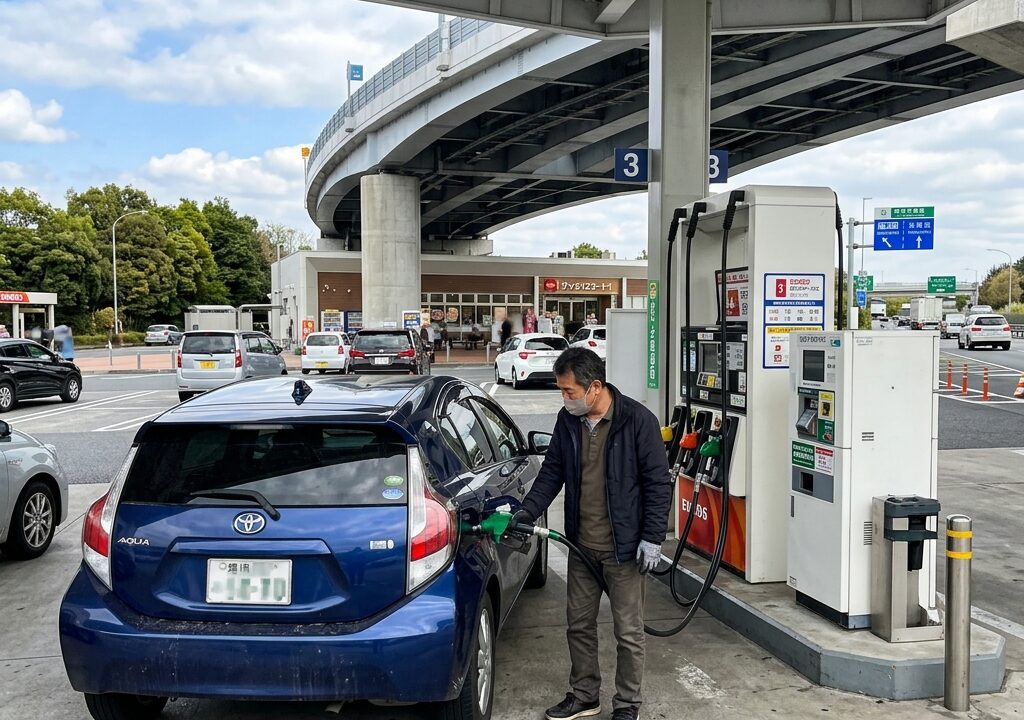
In recent years, self-service stations (marked clearly with the word “セルフ” or “Self” on large signs) have become increasingly common on Japanese highways because they usually offer slightly cheaper fuel prices than full-service stations.
Operating the Touch Screen Menu in Japanese
Using a self-service pump in Japan can be intimidating because the touch screens are almost entirely in Japanese. However, they all follow a very similar, logical progression.
First, touch the screen to begin. The machine will usually ask for your payment method first. Select the button that says “クレジットカード” (Credit Card) or “現金” (Cash). If you select credit, insert your card into the reader; if you select cash, insert your bills. Next, the screen will ask you to select the fuel type. This is the most critical step. Look for the red button labeled “レギュラー” (Regular) for standard gasoline. After selecting the fuel, you must select the amount. You can choose specific cash amounts (e.g., 2,000 yen), specific liter amounts (e.g., 20 liters), or simply press the button that says “満タン” (Mantan) to fill the tank completely. Once the payment is authorized and the settings are confirmed, a voice prompt will usually tell you to remove the nozzle and begin fueling.
Safety Procedures for Dispensing Fuel Yourself
Before you touch the fuel nozzle at a Japanese self-service station, there is a mandatory safety step that you must perform to prevent accidents caused by static electricity.
Next to the touch screen, you will see a prominent, usually black, anti-static pad resembling a handprint. The voice prompt will instruct you to touch this pad (Seidenki jokyo pad) before doing anything else. Place your bare hand firmly on the pad for a second to discharge any static electricity built up on your body from sliding out of the car seats. Once you have touched the pad, open your fuel cap. Lift the correct nozzle (pay strict attention to the colors, which are explained in the next section), insert it into the tank, and squeeze the handle. The pump has an automatic shut-off valve, so if you selected “Mantan” (full tank), it will click off automatically when the tank is full. Do not try to squeeze extra fuel in after the click. Return the nozzle to the holder, replace your fuel cap tightly until it clicks, and collect your receipt from the machine. If you paid with cash and are owed change, a separate machine located nearby will dispense your coins when you scan the barcode on your receipt.
Understanding Fuel Types and Color Codes
The single biggest mistake a foreign driver can make at a gas station is putting the wrong type of fuel into their rental car. Fortunately, Japan uses a strict, universal color-coding system to prevent this.
Red, Yellow, and Green: Decoding the Nozzles
Regardless of the brand of the gas station, whether it is ENEOS or Idemitsu, the fuel nozzles are always color-coded in exactly the same way across the entire country. Memorizing these three colors is essential for self-service refueling.
1. RED is for Regular (レギュラー): This is standard unleaded gasoline (about 90 octane). The vast majority of standard rental cars, including compacts, sedans, and hybrids, run on Regular. If you are unsure, this is almost always the correct choice.
2. YELLOW is for High-Octane (ハイオク): This is premium unleaded gasoline (about 100 octane). It is generally only used for luxury vehicles, high-performance sports cars, or specific European imports. Unless your rental agency explicitly told you to use High-Octane, you do not need to use the yellow nozzle.
3. GREEN is for Diesel (軽油 – Keiyu): This is diesel fuel. It is primarily used for trucks, large vans, and some specific SUV models. The Japanese word for diesel, “Keiyu,” literally translates to “light oil,” which can be confusing because the word for a light compact car is “Kei-car.” Never put green diesel fuel into a standard Kei-car.
What Happens if You Put the Wrong Fuel in Your Rental Car
Putting the wrong fuel into your vehicle is a catastrophic mistake that will destroy the engine and immediately ruin your vacation.
If you accidentally pump green Diesel into a car designed for red Regular gasoline, or vice-versa, the engine will misfire, stall, and suffer severe internal damage. If you realize your mistake *while* you are still at the pump, do not start the engine under any circumstances. Starting the car pulls the incorrect fuel into the engine block. Instead, leave the car turned off, inform the station staff immediately, and call your rental car agency’s emergency number. The car will have to be towed, and the tank will need to be professionally drained and cleaned. You will be held financially responsible for the towing fees, the repair costs, and a “Non-Operation Charge” (NOC) by the rental agency to compensate for the days the car cannot be rented out. This bill can easily reach hundreds of thousands of yen. Always double-check your rental agreement to confirm the fuel type, and when at a self-service pump, confirm you are holding the RED nozzle before you squeeze the handle.
Payment Methods and Rental Car Return Policies
Understanding how to pay for your gas and what documents you need to keep is the final step in mastering the Japanese refueling process.
Using International Credit Cards at the Pump
Most major highway Service Area gas stations, both full-service and self-service, accept major international credit cards (Visa, Mastercard, American Express).
When using a credit card at a self-service terminal, you simply insert the card when prompted. The machine will usually return the card immediately, and the transaction is finalized once you finish pumping the gas. However, be aware that some older, rural stations located off the highway might still be cash-only operations. Additionally, foreign credit cards can occasionally be rejected by automated pumps due to strict fraud prevention algorithms from your home bank. For this reason, you should never let your fuel tank run completely to empty, and you should always carry at least 10,000 yen in cash specifically reserved for buying gas, just in case your card is declined at a remote location.
Providing the “Full Tank Receipt” to Your Rental Agency
When you finally return your rental car at the end of your trip, standard Japanese rental policy dictates that you must return the vehicle with a completely full tank of gas (Mantan).
The rental agency will require proof that you actually filled the tank right before returning the car. They will ask you to produce the paper receipt from the gas station located closest to the rental office (usually within a 5-kilometer radius). This receipt proves that the tank was filled recently and that you put the correct type of fuel (Regular) into the car. Therefore, it is critical that you do not throw away your final gas receipt. Keep it in your wallet or the cup holder. If you lose the receipt, or if you return the car without a full tank, the rental agency will charge you for the estimated missing fuel at a premium rate that is significantly higher than the pump price, plus an additional penalty fee. Returning the car full and handing over the receipt is a polite and necessary conclusion to your driving experience in Japan.
Conclusion
Refueling a rental car in Japan might seem complex at first glance, but the system is designed with incredible logic, safety, and customer service in mind. Whether you choose the pampered experience of a full-service station or the slightly cheaper efficiency of a self-service pump, the process is straightforward once you know the basic steps.
The most important takeaway for any international driver is to rely on the universal color-coding system: stick to the RED nozzle for Regular gasoline unless instructed otherwise, and never let the GREEN diesel nozzle near a standard car. Take advantage of the full-service stations when you need a clean windshield and want to dispose of road trip trash, but do not be afraid to tackle the self-service touch screens using the simple “Regular, Mantan” method. By monitoring your fuel gauge carefully on long highway stretches and keeping that final receipt for the rental agency, buying gas simply becomes another interesting cultural experience on your Japanese road trip.