Tokyo to Kanazawa by Car: Best Highway Route, SA Stops & Hokuriku Expressway Guide
So you’ve rented a car in Tokyo and are planning a road trip to the beautiful city of Kanazawa? Excellent choice. While Japan’s Shinkansen (bullet train) is famous for its speed, driving gives you the freedom to explore the country at your own pace, discover hidden gems, and experience one of the most underrated parts of Japanese travel culture: the highway Service Area (SA) and Parking Area (PA).
This guide is for travelers getting behind the wheel. We’ll skip the jargon and give you the practical advice you need. We’ll cover the best route to take, which rest stops are actually worth your time, and what to expect on the final stretch along the Hokuriku Expressway.
This is about making the drive itself a memorable part of your Japan adventure.
Choosing Your Route: Kan-Etsu vs. Chuo Expressway
Right out of the gate, you have two primary options for the drive from Tokyo to Kanazawa. Both routes will eventually merge onto the Hokuriku Expressway, but the first half of the journey offers different scenery and experiences. There’s no single “best” route; it really depends on what you want to see along the way.
The Kan-Etsu & Hokuriku Expressway Route (The Classic Choice)
This is generally the most common and often slightly faster route. You’ll start by heading north from Tokyo on the Kan-Etsu Expressway, cutting through the plains of Saitama and Gunma prefectures before climbing into the mountains of Nagano. After a scenic drive, you’ll connect to the Joshin-Etsu Expressway and finally merge onto the Hokuriku Expressway towards Kanazawa. This route offers a great mix of landscapes, from urban sprawl to rolling mountains and finally, stunning coastal views.
The drive is straightforward, well-signed, and features some of Japan’s best-equipped Service Areas. In good weather, it’s a beautiful and relaxing drive. However, be aware that the Nagano mountain pass section can be subject to snow and ice from late November to April, so checking road conditions is essential during those months. The total drive time without major traffic or long stops is typically around 5.5 to 6.5 hours. It’s a fantastic option for first-time drivers in Japan who want a reliable and scenic journey.
Route Details Information Main Expressways Kan-Etsu Expressway → Joshin-Etsu Expressway → Hokuriku Expressway Approx. Distance ~470 km (292 miles) Approx. Drive Time 5.5 – 6.5 hours (without traffic/stops) Approx. Toll Fee (Standard Car) ~¥10,000 – ¥12,000 (Varies with ETC discounts)
The Chuo & Hokuriku Expressway Route (The Japan Alps Route)
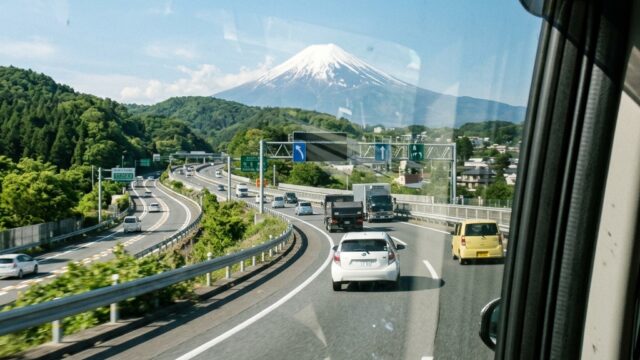
For those who want to drive through the heart of the Japan Alps, the Chuo Expressway is a fantastic alternative. This route takes you west out of Tokyo, offering dramatic mountain scenery almost immediately. You’ll pass by famous areas like Yamanashi (home to Mt. Fuji) and Suwa before heading north on the Nagano Expressway to meet the Hokuriku Expressway. This path feels a bit more rugged and mountainous.
This route is especially beautiful during autumn when the leaves are changing color. It can sometimes be a bit more challenging with more curves and tunnels, but the views are your reward. It’s also a great choice if you’re planning a side trip to places like Matsumoto Castle. Similar to the Kan-Etsu route, the mountain sections are prone to winter weather, so be sure your car is equipped with snow tires if you’re traveling in the colder months. Tolls and distance are very similar to the Kan-Etsu route, so the decision really comes down to personal preference for scenery.
Route Details Information Main Expressways Chuo Expressway → Nagano Expressway → Hokuriku Expressway Approx. Distance ~480 km (298 miles) Approx. Drive Time 5.5 – 6.5 hours (without traffic/stops) Approx. Toll Fee (Standard Car) ~¥10,000 – ¥12,000 (Varies with ETC discounts)
Essential Pre-Drive Checklist for Your Rental Car
Before you hit the highway, a few simple checks on your rental car can save you a world of hassle later. These are the absolute basics to get sorted before leaving the rental agency parking lot.
Getting Your ETC Card and Why You Need It
When you book your rental car, you’ll almost always see an option to add an ETC (Electronic Toll Collection) card. Do it. Seriously, this little card is an essential tool for a smooth Japanese road trip. Most rental agencies offer it for a small flat fee (around 330 yen) for the duration of your rental. The tolls themselves will be calculated and charged to your credit card when you return the car.
The main benefit is convenience. Instead of stopping at every toll gate, fumbling for cash or a credit card, and trying to communicate with the staff, you just slow down and drive through the designated “ETC” lane. A small chime will sound, and the barrier will lift automatically. It’s incredibly efficient. Plus, using ETC often gives you access to discounts, especially during off-peak hours or on weekends. If you’re wondering about the details, we have a complete guide on how to use ETC in Japan. Don’t leave the rental office without confirming you have one and that it’s inserted correctly into the reader (usually a small box mounted on the dashboard or near the glove compartment).
Navigation and Connectivity on the Go
Most rental cars in Japan come with a built-in GPS navigation system. The good news is that many of them can be switched to English. However, they can sometimes be a bit clunky to use, especially when searching for destinations in English. The single most useful feature is the ability to input a destination using its phone number. This is incredibly accurate and bypasses any language barriers. Before you go, look up the phone numbers of your hotel, sights you want to see, and even the SA/PA stops you plan to visit.
That said, you should still have a backup. Google Maps or Apple Maps on your smartphone work great in Japan and provide real-time traffic information, which the in-car GPS might not. This means you’ll need a reliable data connection. Renting a pocket Wi-Fi device or getting an eSIM for your phone is highly recommended. It will not only help with navigation but also allow you to look up information about your stops on the fly. Set your destination in both your car’s GPS and your phone before you start driving. This gives you redundancy and lets you cross-reference if one seems to be giving you strange directions.
Top Service Area (SA) Stops on the Kan-Etsu Expressway
The journey is just as important as the destination, and nowhere is this truer than on Japan’s expressways. Service Areas (SA) are large rest stops, almost always equipped with 24-hour gas stations, EV charging stations, restaurants, and extensive souvenir shops. Parking Areas (PA) are typically smaller, but some can be surprisingly good. Here are a couple of must-visit spots on the first leg of your trip.
Miyoshi PA (Outbound): Your First Taste of Highway Culture
About 30-40 minutes after navigating the urban maze of Tokyo, you’ll see signs for Miyoshi PA. This is the perfect place for your first stop. It’s not a massive, sprawling complex, but it’s an ideal introduction to what Japanese rest stops are all about. It’s clean, efficient, and gives you a chance to stretch your legs and grab your first “highway meal.”
The food court here is a great place to start. You’ll likely find a ticket machine system. Don’t be intimidated! Most have pictures, and some even have English buttons. You select your meal (ramen, udon, soba, or a curry rice set are all safe bets), insert your cash, and take the printed ticket to the corresponding food counter. They’ll call your number when it’s ready. This is how most SA/PA food courts work. The quality is surprisingly high—far better than the fast food you might expect at a highway stop back home. The souvenir shop at Miyoshi PA is also worth a quick look. You’ll find snacks and treats specific to the Saitama region, which is a great way to start your collection of local “omiyage” (souvenirs). Check out our beginner’s guide to Japanese highway food courts to learn more.
Takasaka SA (Outbound): A Family-Friendly Stop with Local Saitama Flavor
Further up the Kan-Etsu Expressway, Takasaka SA is a much larger facility and a great place for a longer break. If you’re traveling with kids, this is an excellent choice as it often has more green space to run around and sometimes even small playgrounds. It’s a bustling hub that showcases local products and food from Saitama Prefecture.
The food options here are more extensive. You might find stalls selling “yakitori” (grilled chicken skewers) from Higashi-Matsuyama, a local specialty, or soft-serve ice cream infused with Sayama tea, another regional product. This is where you really start to see how SAs act as showcases for local cuisine. Inside, the souvenir shop is massive. You’ll find everything from beautifully packaged sweets to local crafts and even produce from nearby farms. One thing to look out for is the “Highway Stamp” corner. Many SAs have a unique rubber stamp and ink pad for you to commemorate your visit in a notebook—a fun and free souvenir. The restrooms, like at all Japanese SAs, will be impeccably clean, often featuring heated seats and other high-tech features that can be a pleasant surprise for first-time visitors.
Must-Visit Stops on the Hokuriku Expressway
After you’ve navigated the mountains of Nagano, you’ll merge onto the Hokuriku Expressway. The landscape changes dramatically as you descend towards the coast. This is the final and arguably most beautiful stretch of your drive, with the Sea of Japan coming into view.
Yoneyama SA (Outbound): Unbeatable Views of the Sea of Japan
This is the stop you make for the view. Yoneyama SA is perched on a cliffside, offering panoramic views of the Sea of Japan. On a clear day, you can even see Sado Island in the distance. Time your drive to arrive here around sunset for a truly spectacular sight. There are observation decks and benches perfectly positioned for you to soak it all in.
The restaurant and food court here are designed to take full advantage of the location, with large windows facing the ocean. This is the perfect place to try some local seafood. Look for dishes featuring fresh fish from the nearby Kashiwazaki port. Even if you’re just grabbing a coffee and a snack from the kiosk, take it outside to the observation deck. Many travelers consider this one of the most scenic rest stops in all of Japan. There’s also a small souvenir shop specializing in products from the Niigata region, like rice crackers and sake-related goods. This stop is less about the amenities and all about the million-dollar view, making it an essential part of the Tokyo-to-Kanazawa experience.
Arisoumi SA (Outbound): Gateway to Toyama’s Seafood Delights
As you get closer to Kanazawa, you’ll enter Toyama Prefecture, famous for its incredible seafood from Toyama Bay. Arisoumi SA is your best opportunity to sample these local treasures before reaching your final destination. The name “Arisoumi” is an old name for Toyama Bay, and this SA lives up to its name.
The must-try item here is anything with “shiro ebi” (white shrimp), a tiny, sweet shrimp that’s a local delicacy. You can find it in savory crackers, croquettes, and even as a topping on soft-serve ice cream (it sounds weird, but it’s surprisingly good!). Another famous Toyama product is “masuzushi,” a type of pressed trout sushi wrapped in bamboo leaves. The souvenir shop at Arisoumi SA will have many different versions from various famous shops, making it a convenient place to buy some for later. The food court will also heavily feature dishes with local seafood. While English menus might be sparse, the picture menus are usually very clear. Just point to what looks good—you really can’t go wrong with the seafood here. It’s an excellent culinary pit stop and your final taste of highway culture before arriving in Kanazawa.
Practical Tips for Driving the Hokuriku Expressway
The final leg of your journey on the Hokuriku Expressway is beautiful but comes with its own unique set of driving conditions. Being prepared for them will ensure your drive is safe and stress-free, allowing you to enjoy the coastal scenery.
Dealing with Winter Conditions (Snow and Ice)
This cannot be stressed enough: if you are driving this route between late November and early April, you are in snow country. The Hokuriku region receives some of the heaviest snowfall in the world. Do not attempt this drive in winter without a car equipped with snow tires. When you rent your car, make sure you select the “snow tires” option. It’s a small extra fee that is absolutely non-negotiable for safety.
Even with snow tires, you need to drive differently. Speed limits will be reduced (look for electronic signs), and you should dramatically increase your following distance. Bridges and tunnel entrances are particularly prone to icing over. Some sections may have small fountains spraying saltwater on the road to prevent freezing. Be prepared for sudden changes in weather; it can go from clear to a whiteout blizzard in minutes. If the weather gets too bad, highway authorities may close the expressway entirely. You can check real-time road conditions on the NEXCO (Nippon Expressway Company) website, which has some English information available. Thinking about winter driving? Our guide to snow tires vs. chains can help.
Understanding Tunnels and Crosswinds
The Hokuriku Expressway hugs the coastline and cuts through mountains, which means two things: lots of tunnels and sections exposed to strong crosswinds from the Sea of Japan. The sheer number of tunnels can be a bit disorienting. Always ensure your headlights are on (most modern cars do this automatically) and be mindful of the speed limit inside, which is often lower than on the open road.
The crosswinds can be a more serious issue, especially for lighter vehicles. You’ll see windsock-style indicators (called “fukinagashi”) along the side of the road. If they are flying straight out horizontally, be prepared for strong gusts. This is most common on long bridges and open coastal sections. Keep both hands firmly on the steering wheel and be prepared to make small corrections to stay in your lane. Overtaking large trucks in these conditions can be particularly tricky, as you’ll experience a sudden gust when you pull out from behind them. It’s not a reason to avoid the route, but it is something to be mentally prepared for. Driving with a little extra caution will ensure you arrive safely.
Conclusion
Driving from Tokyo to Kanazawa is more than just a long commute; it’s a road trip that showcases the incredible diversity of Japan’s landscapes. From the bustling metropolis of Tokyo, through the majestic Japan Alps, and along the dramatic coastline of the Sea of Japan, the journey is an adventure in itself. The freedom of having your own car allows you to set your own schedule, discover places you’d never see from a train window, and truly immerse yourself in the culture of the open road. The real secret to enjoying this drive is to embrace Japan’s unique highway culture. Don’t think of the Service Areas and Parking Areas as just places to refuel and use the restroom. Treat them as mini-destinations. Sample the local specialties at each stop, from Saitama’s tea-flavored ice cream to Toyama’s delicate white shrimp. Pick up unique souvenirs you won’t find anywhere else. Take a moment to enjoy the stunning ocean view from Yoneyama SA. These small experiences are what turn a simple drive into a memorable journey. By planning ahead—securing an ETC card, understanding your navigation options, and preparing for the specific challenges of the route like winter snow—you can ensure a smooth, safe, and incredibly rewarding trip. You’ll arrive in Kanazawa not just transported, but with a deeper appreciation for the country you’ve just driven across.